For pipe diameters exceeding DN800, direct extrusion demands prohibitively large extruders, high clamping forces, and complex cooling systems. The spiral winding process—where a profile extruder first produces a continuous HDPE strip (square or rectangular hollow section), which is then helically wound and fusion‑welded onto a rotating mandrel—offers clear advantages:
| Aspect | Direct Extrusion | Spiral Winding |
|---|---|---|
| Max economical diameter | ~DN1200 | Up to DN4000 |
| Investment cost | Very high | Moderate (2–3 extruders) |
| Ring stiffness flexibility | Fixed by wall thickness | Adjustable via profile design |
| Material use (kg/m) | Higher (solid wall) | Lower (hollow core structure) |
| Recycled material usage | Limited (≤20%) | Up to 100% (with proper screw design) |
The winding process also allows real‑time adjustment of the pipe's wall structure, enabling the same production line to manufacture pipes with ring stiffness ratings from SN4 (4 kN/m²) up to SN16 (16 kN/m²) simply by changing the winding pitch or profile dimensions.
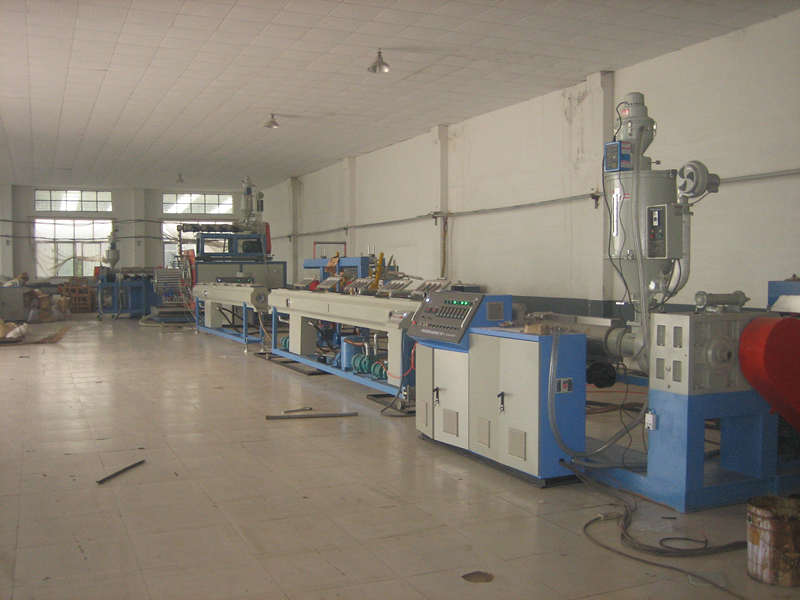
A complete large‑diameter winding pipe production line typically comprises the following stations:
Main Profile Extruder – produces the continuous hollow strip (the load‑bearing structure).
Co‑extruder (Melt Adhesive Extruder) – applies molten HDPE at the welding points to fuse adjacent strip layers.
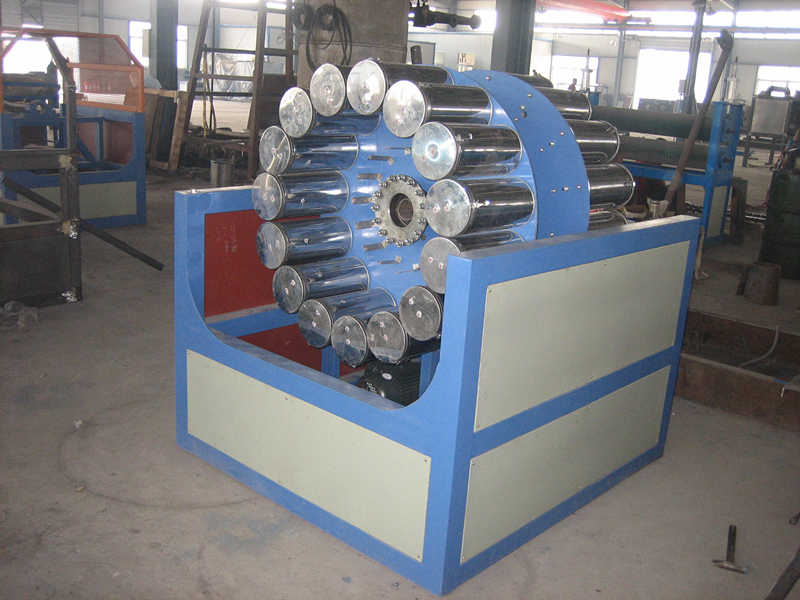
Spiral Winding Forming Machine – a multi‑axis rotating mandrel that controls pipe diameter and winding angle.
Annealing/Cooling Section – ensures stress relief and dimensional stability.
Automatic Cut‑off Saw – performs in‑line cutting to customer‑specified lengths.
PLC Central Control System – synchronises all extruders, the winding carriage, and the haul‑off.
The table below summarises the most common commercially available models, with parameters sourced from leading Chinese and European machinery manufacturers (values are typical; final specs depend on supplier customisation).
| Model Code | Pipe OD Range (mm) | Main Extruder | Melt Extruder | Installed Power (kW) | Max Output (kg/h) | Typical Application |
|---|---|---|---|---|---|---|
| WR‑800 | 200 – 800 | SJ65/34 (65 mm screw, 34 L/D) | SJ55/34 | ~210 | 380 – 420 | Branch sewers, residential drainage |
| WR‑1200 | 300 – 1200 | SJ80/34 | SJ65/34 | ~320 | 530 – 570 | Municipal trunk lines, treatment plants |
| WR‑2200 | 800 – 2200 | SJ90/38 (high‑torque) | SJ65/34 | ~430 – 460 | 720 – 850 | Stormwater mains, industrial cooling water |
| WR‑3000 | 1200 – 3000 | SJ120/38 (twin‑stage decompression) | SJ80/34 | ~530 – 560 | 880 – 950 | Large outfalls, cross‑river siphons |
| WR‑4000 | 1800 – 4000 | SJ150/38 + forced feeding | SJ90/34 | ~680 – 720 | 1100 – 1250 | Mega‑projects, tunnel lining pipes |
Note: All models above operate with a maximum line speed of 0.5 – 1.2 m/min depending on pipe diameter and wall thickness. The winding angle is adjustable between 50° and 85° to optimise ring stiffness vs. axial strength.
Beyond the basic parameters, the following engineering details determine whether your line runs trouble‑free for a decade or becomes a maintenance nightmare.
For cost‑competitive production, the ability to process post‑industrial regrind (100% flakes) is non‑negotiable. Look for:
High‑torque, low‑speed drive systems (gear‑box efficiency > 95%).
Double‑stage decompression screws with a barrier section – this prevents bridging and ensures homogeneous melting even with variable‑size feed.
Hard‑facing (e.g., tungsten‑carbide coating) on the screw flight tips – extends service life when processing abrasive recycled material.
Parameter to check: Melting capacity with 100% regrind should be at least 85% of the virgin‑material rate (many cheap designs drop to 60%).
The forming mandrel must maintain concentricity within ±0.5 mm for DN2000 pipes. Key specifications:
Number of drive axes: ≥ 4 independent servo‑driven axes (radial expansion, axial movement, mandrel rotation, and strip guide).
Hydraulic clamping pressure: adjustable from 0.5 – 2.5 MPa to ensure proper fusion welding without crushing the hollow profile.
Quick‑change diameter system: tool‑less adjustment time ≤ 30 minutes for diameter changes within the same model range.
While most suppliers offer Siemens S7‑1500 or Allen‑Bradley PLCs, the critical feature is dual‑screen independent synchronisation – the main extruder and the winding carriage must have separate operator panels but communicate via a high‑speed industrial Ethernet bus (PROFINET or EtherCAT). This allows:
Independent speed trimming during diameter changes.
Automatic torque compensation when the pipe wall thickness varies.
Real‑time data logging (including melt temperature, pressure, and winding torque) for full traceability.
A well‑configured winding line is not limited to standard double‑wall spiral pipes. With the right auxiliary tooling, it can produce:
Triple‑wall wound pipes – for extra high ring stiffness (SN16) using an inner and outer corrugated layer.
Ribbed (T‑type) profile pipes – for reduced weight while maintaining SN8.
Solid‑wall wound pipes – when a smooth internal bore is required for high‑flow applications (Manning coefficient n ≤ 0.009).
The changeover between these profiles typically requires swapping only the profile extrusion die and adjusting the winding pitch – a 2‑hour operation for an experienced crew.
| Cost Item | Typical Range | Optimisation Tip |
|---|---|---|
| Machine base price (WR‑2200) | USD 380,000 – 480,000 (FOB) | Compare screw material (nitrided steel vs. bimetallic) |
| Installation & commissioning | 8 – 12% of machine cost | Choose suppliers offering on‑site training for 2 weeks |
| Energy consumption | 180 – 250 kWh/tonne of pipe | Look for inverters on all motors (standard in EU‑spec lines) |
| Tooling (dies & mandrels) | USD 15,000 – 30,000 per diameter | Negotiate a starter set (3 diameters) in the package |
| Annual maintenance budget | 3 – 5% of purchase price | Focus on spare parts for the winding gearbox – longest lead time |
The global HDPE pipe market is projected to grow at 5.8% CAGR through 2030, driven by aging water infrastructure replacement and new greenfield industrial parks. For manufacturers, the winning strategy is:
Invest in a line with at least one diameter above your current largest order – e.g., a WR‑3000 if you primarily sell DN2000 – to capture unexpected large‑tender opportunities.
Demand a factory acceptance test (FAT) using your own recycled material blend – not just virgin pellets – to verify the screw's real‑world performance.
Prioritise suppliers that offer remote diagnostics (IoT‑ready controllers) – this cuts downtime by 40% in our field experience.
HDPE large‑diameter winding pipe machinery is a sophisticated but well‑understood technology. The key to a profitable investment lies not in the flashiest headline numbers, but in screw design for recyclates, forming mandrel precision, and control system synchronisation. Use the parameter tables and technical checkpoints above as your procurement checklist. When evaluating vendors, always request process data (melt temperature profile, specific energy consumption, and diameter tolerance) from an actual production run – not just a brochure.